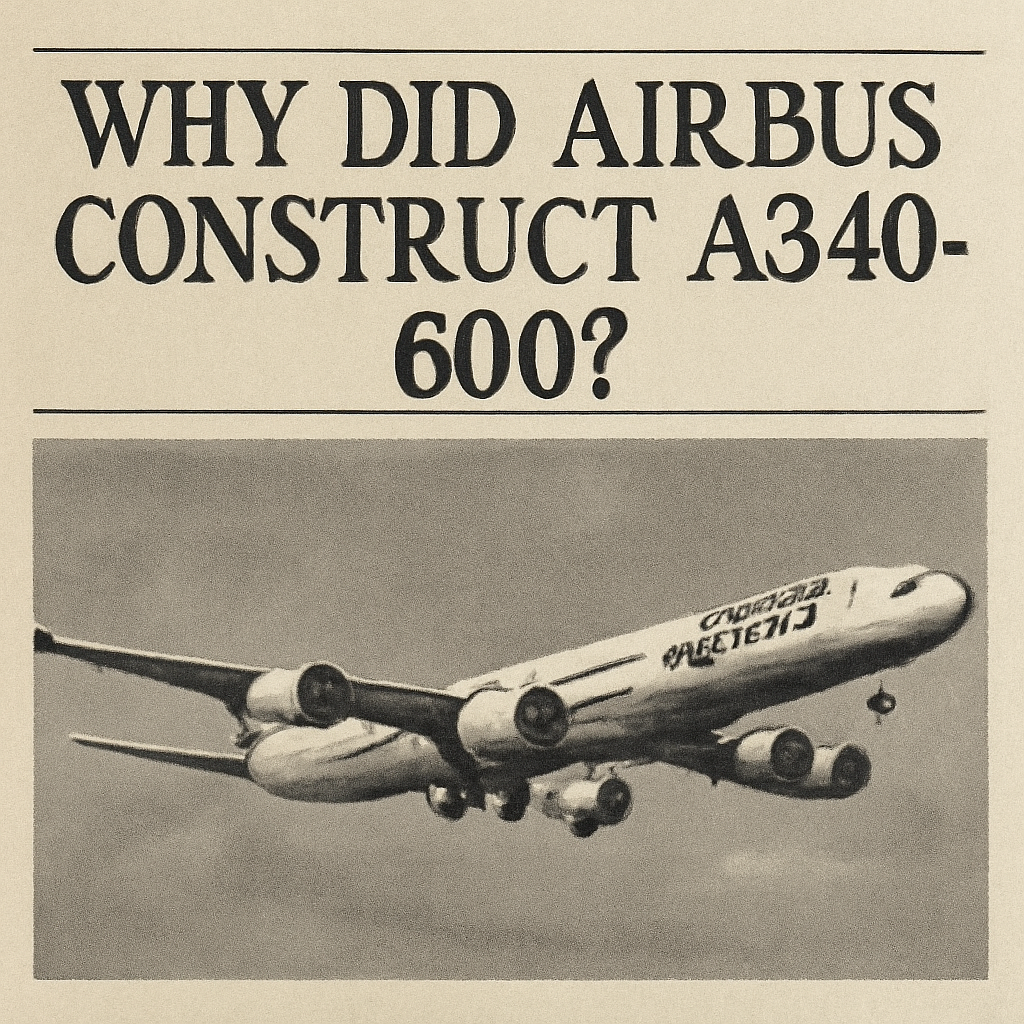

The Airbus A340-600, a widebody aircraft, was admired by aviation enthusiasts for its slender design, much like the Boeing 757, often referred to as the ‘flying pencil.’ With Lufthansa having recently retired the last of its fleet, the A340-600 has reached the end of its service with its initial operators. Its retirement coincides with the impending phase-out of the remaining commercial A340-300s.
Nevertheless, both aircraft have a future in Iran. The A340-600 was designed with an elongated fuselage to compete against the broader and double-decked Boeing 747-400. With limitations in width and height, length became the only dimension available for Airbus engineers to enhance.
This trend continues today. Although Airbus has not disclosed the anticipated length of the proposed stretched A350-2000, which is under serious consideration, it is reasonable to estimate it will measure approximately 260 feet (80 meters). If realized, this would make it over 10 feet (four meters) longer than the A340-600.
The Reason Behind Airbus Developing The A340
The Airbus A330 and A340 series of widebody aircraft represent some of the most significant achievements in Airbus’ history, helping to solidify the company as one of the two leading manufacturers of airliners today. The A340 series, featuring four engines, was developed during a time when ETOPS was still in its early stages. Airbus produced a total of 377 A340 aircraft, but the twin-engine A330 ultimately proved to be more successful and was later upgraded to the A330neo.
The A340 series encompassed the A340-200, A340-300, A340-400, and A340-600 variants. It was intended to replace earlier models of the Boeing 747-200/-300 and could accommodate 379 passengers in a three-class configuration. With a range of 7,500 nautical miles, it was capable of servicing long-haul routes, and its four-engine setup allowed it to bypass aircraft diversion regulations.
However, as ETOPS regulations for twin-engine aircraft improved and engine technology advanced, the quad-engine design became less advantageous. The A340 struggled to compete with twin-engine jets. Between 2002 and 2010, a total of 97 A340-600s were manufactured and delivered. In comparison, 28 A340-200s, 218 A340-300s, and 34 A340-500s were produced.
Longer Than Earlier Boeing 747 Models
The A340-600 was designed as a single-deck, quad-engine alternative to the earlier 747 models. The simplest method for Airbus to increase capacity without adding an upper deck or widening the aircraft was to extend the fuselage. The A340-600 measures 247 feet and three inches (75.36 m) in length, significantly surpassing the earlier 747 models prior to the 747-8. The 747-100, 747-200, 747-300, and 747-400 all measured 231 feet and ten inches (70.66 meters).
This makes the A340-600 approximately 15 feet (five meters) longer than the 747. The final variant, the 747-8, was longer at 250 feet and two inches (76.25 meters). Additionally, the A340-600 was notably longer than its A340 counterparts. The A340-200 was 194 feet and ten inches (59.39 meters), the A340-300 was 208 feet and 11 inches (63.69 meters), and the A340-500 measured 222 feet and ten inches (67.93 meters).
However, a more significant measurement is the usable cabin length. The A340-600 offers around 200 feet (61.0 meters) of passenger cabin space, while the main deck of the Boeing 747-100 measured between 185 and 187 feet (56.4-57.0 meters). This indicates that its usable cabin area was slightly less than what its overall comparative length might imply.
Boeing 747-400s Were Already Aging When The A340-600 Entered Service
The A340-600 was engineered to accommodate approximately 380 passengers in a standard three-class layout. Interestingly, this capacity was roughly comparable to that of some early 747 configurations, despite the 747 being significantly wider. The additional width of the 747 allowed for ten seats across (3-4-3) in economy class on the main deck, while the narrower fuselage of the A340 could only fit nine seats (3-3-3).
In contrast to the expansive A380, the upper deck of the 747 was relatively narrow. Over time, Boeing made substantial enhancements to the upper deck of the 747.
Airbus introduced the A340
Source: Original article