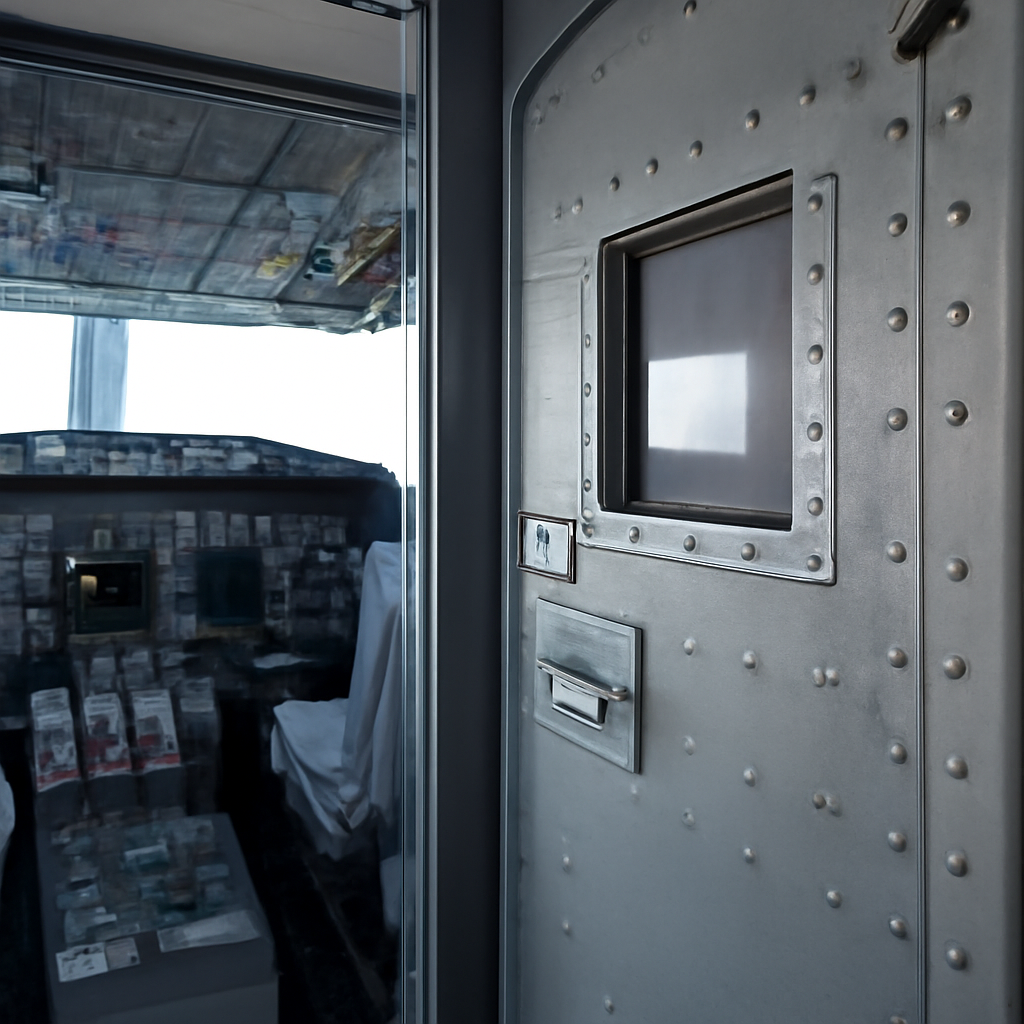

Contemporary aircraft cockpits feature dual layers of security. The primary layer consists of a fortified door, which was implemented after the September 11 attacks in 2001. These doors are engineered to resist forced entry attempts and small-arms fire, and they are mandatory on all passenger and large cargo planes operating in the US.
Additionally, the latest aircraft models are equipped with a secondary barrier, typically a lockable gate. This measure was introduced to guarantee that there is always at least one barrier to the cockpit, particularly when a pilot opens the reinforced door to access the restroom.
The Barrier Introduced After 9/11
During the events of 9/11, the terrorists faced relatively weak barriers that allowed them to breach the cockpit. To prevent a recurrence of such attacks, the Federal Aviation Administration (FAA) mandated the installation of reinforced cockpit doors. These doors are constructed to be impervious to manual forced entry and can withstand small arms fire. In the past, cockpit doors were often flimsy, made from thin aluminum. Today, they feature reinforced frames, steel plates, and Kevlar composites.
Further safety enhancements have been made by modifying in-flight protocols. Prior to 9/11, it was common for crew members to make routine and casual visits to the cockpit. Such practices have been completely abolished. Now, pilots lock the door from the inside during flights, utilizing specialized internal keypads, delayed-release toggles, and pilot override switches.
The FAA enforces stringent regulations that new reinforced door designs must adhere to in order to gain certification under FAA Advisory Circular 25.795-1. For instance, these doors must endure impact tests from a 100 lb (45 kg) pendulum, exerting a force greater than that of an individual attempting to break them down. Additionally, the doors must include decompression blow-out panels. This technology is crucial because the reinforced doors are nearly airtight, which could lead to a hazardous pressure difference between the cabin and cockpit in the event of rapid decompression.
Unintended Vulnerabilities Of The Reinforced Doors
The introduction of reinforced doors has also led to some unforeseen safety challenges in American commercial aviation. While these doors significantly hinder intruders from accessing the cockpit, if an intruder does manage to enter, the reinforced door serves as a strong barrier against passengers or crew members attempting to intervene.
The isolation created by the internally locking reinforced door can pose a risk if the pilots become incapacitated. Some airlines have implemented procedures such as the two-person cockpit rule, which mandates that a crew member must enter the cockpit whenever one pilot leaves, ensuring that there is never a solo pilot.
A single barrier also presents a concerning moment of vulnerability. Especially during long-haul flights, pilots may leave the cockpit to use the restroom or for crew changes. In doing so, they must open the cockpit door, creating an opportunity for an intruder to gain access.
The Campaign For A Secondary Barrier
Two years ago, the Biden administration introduced the FAA Reauthorization Act of 2024. This legislation mandates that all commercial aircraft must have a secondary barrier, addressing the vulnerabilities associated with the single reinforced door that is locked from the inside. The implementation of this requirement is anticipated to take five to six years, meaning many aircraft will continue to operate in the US with only a single reinforced door for years to come.
“Every day, pilots and flight crews transport millions of Americans safely – and today we are taking another important step to make sure they have the physical protections they deserve,” stated former US Transportation Secretary Pete Buttigieg.
This law was the result of over two decades of advocacy by Ellen Saracini, whose husband, United Airlines Captain Victor Saracini, lost his life when United Flight 175 was hijacked and crashed into the World Trade Center.
“It’s insulting to the pilots and crews that died on September 11. I can’t look another victim’s family in the eye and say that we haven’t done enough to protect them,” she expressed.
Source: Original article