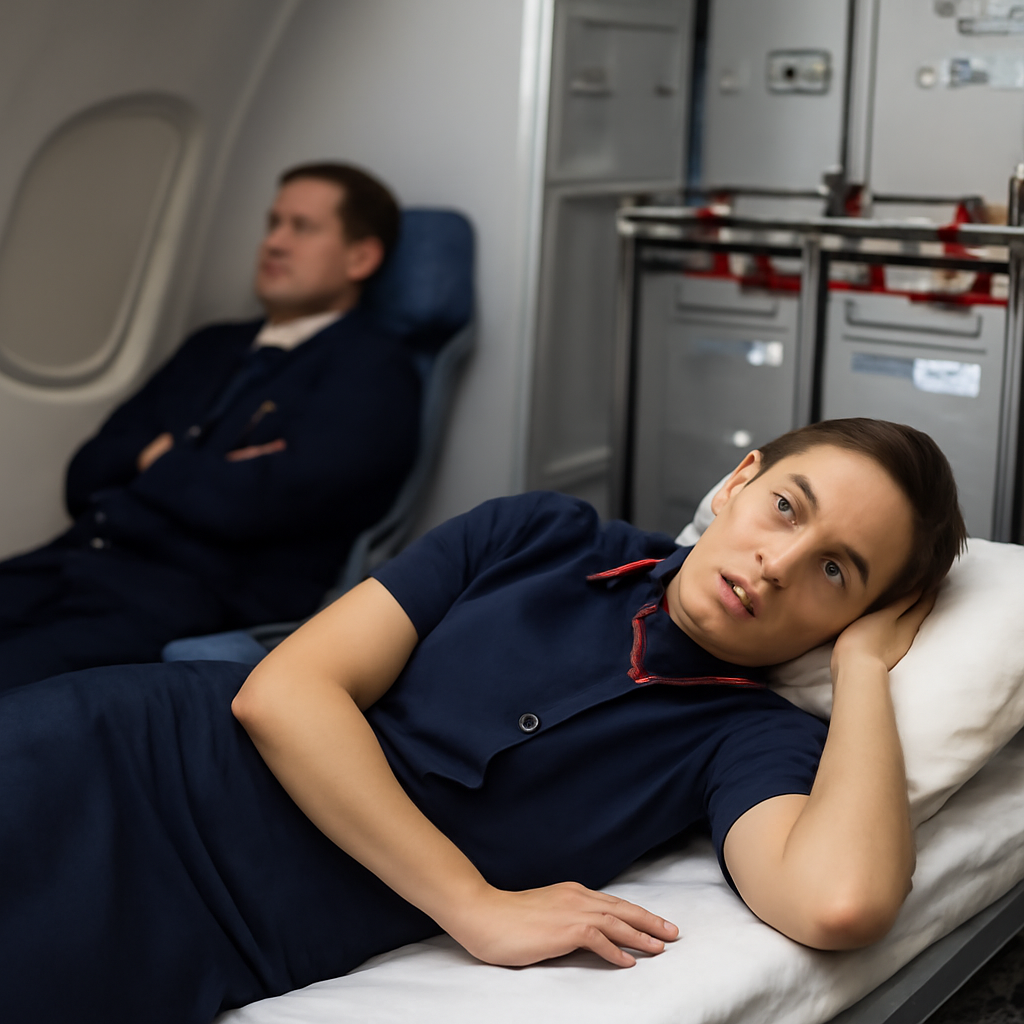

On many ultra-long-haul flights, cabin crew rest does not simply involve finding an empty row and hoping to avoid being called for refreshments. Aircraft like the Airbus A350-1000 are built to accommodate additional staff, allowing the team to take scheduled breaks, ensuring they remain alert for service and, crucially, for any emergencies that may arise.
The key aspect is that the sleeping quarters are deliberately concealed from passengers, located behind unmarked doors and positioned above or below the passenger cabin, effectively isolating them from the activity in the economy section. On most Airbus A350s, passengers are unaware of a small sleeping area accessed through a crew-only door in the galley. Typically, this entry point is found at the rear galley, where cabin crew ascend a compact staircase to reach the crew rest area instead of entering at aisle level.
Inside, the space is functional and dimly lit, featuring bunks, curtains, basic controls, and sufficient room for cabin crew to recharge before returning to serve coffee and respond to call bells. We will explore the layout of these rest areas, their contents, how crew rotations are managed, and how safety regulations influence everything from bunk dimensions to seatbelts and oxygen systems. It is also crucial to highlight that this crew rest area has no role in flight control and lacks any avionics.
A Discreet Space With a Hidden Entrance
The essential element of the Airbus A350-1000’s cabin rest system is how passengers can easily pass by this crew rest area without realizing it is there. On most aircraft, the access point to this specific crew rest area is a subtle door located in or near the rear galley. From this point, crew members do not enter a room but instead ascend. They navigate a narrow staircase leading to a compartment above the passenger cabin.
This vertical separation is primarily what the cabin design aims to achieve, providing privacy and tranquility for passengers without sacrificing significant space at the aisle level. Airlines also prefer the galley-adjacent location for operational simplicity. Working crew members can transfer responsibilities, take a scheduled rest, and then return to the cabin without passengers even noticing.
Since these areas are strictly off-limits to customers, they are usually behind unassuming doors that do not reveal what lies beyond. Those who have accessed these spaces often describe them as efficient and entirely concealed from passengers, who remain unaware of the sleeping area onboard the aircraft.
It is worth noting that the crew-rest configurations on Airbus A350s can differ by airline. Some aircraft have bunks positioned directly above the cabin (often referred to as a crown configuration), while others place them below the main deck, accessed by ladders or stairs. The A350-1000’s function on long-haul flights makes it one of the aircraft with the most well-documented crew rest areas.
Elevated Bunks, Privacy Curtains & Advanced Controls
Upon reaching the crew rest area via the stairs, the atmosphere resembles a compact sleeper car rather than anything particularly opulent. Most crew rest areas are designed with a small central entry space that leads into several bunk bays, typically arranged along the sides. Each bunk acts as its own little cocoon, equipped with a mattress pad, a privacy curtain, and other essential features that become significant during the tenth hour of a fifteen-hour flight.
Reports on modern widebody flights detail the standard amenities found in these compartments, including bunks with seat belts, reading lights, and storage for small personal items. All these elements are designed to ensure that the crew can rest safely during turbulence while remaining accessible when needed. Some configurations even include a small sitting area or jumpseat-like chair near the entrance, along with signage and controls that facilitate the crew’s use of the space.
Source: Original article