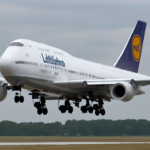

The Boeing 787 Dreamliner entered the market ahead of the Airbus A350-900, resulting in its greater popularity among widebody aircraft in the age of next-generation composite jets. Nevertheless, both aircraft share numerous technical characteristics, along with some distinctive differences. A comparison of the 787-10, which closely matches the size of the A350-900, highlights the contrasting engineering philosophies of these two aerospace giants.
Although both manufacturers designed these aircraft to take advantage of composite materials and advanced digital avionics, the subtle variations in their target markets and specific missions led to unique design features that set them apart. For instance, the A350-900 has a taller nose profile that maintains a level cabin floor, unlike the A340’s nose, which tilts forward.
Both jets incorporate a considerable amount of carbon fiber-reinforced plastic in their airframe construction. The A350 has a slight edge, with this material constituting 53% of its weight, while the Boeing model is not far behind. Additionally, Airbus entered the market later, and although it has not achieved the record-breaking orders that have made the Dreamliner the best-selling widebody aircraft ever, the company has utilized further technological advancements to enhance its A350s.
What Is Semi-Levered Gear? Boeing encountered specific engineering challenges when developing the 787-10, as it is a double-stretched variant of earlier models, measuring 224 feet in length. Consequently, the 787-10 features a unique semi-levered landing gear system, unlike the A350-900, which uses a conventional center-pivoting main landing gear bogie.
This distinction stems from the differing dynamics of the two aircraft during takeoff rotation. The mechanism effectively ‘stretches’ the landing gear, enabling the main strut to elevate the fuselage further off the ground. Had Boeing opted for a standard center-pivot landing gear for the extended fuselage, the tail could potentially strike the runway at a shallow takeoff angle, thereby restricting the rotation speed during takeoff.
The cabin extension causes the tail structure to extend significantly behind the main landing gear compared to the shorter 787-8 and 787-9 models. During takeoff, the gear employs a hydraulic actuator to limit the tilt of the main wheel bogie, which in turn raises the main strut and lifts the fuselage higher. In contrast, Airbus approached the A350-900 as a clean-sheet project, unlike the 787-10.
As a result, engineers predetermined the height of the landing gear struts from the beginning to avoid the complications of a secondary mechanical locking system, thus ensuring smoother and safer takeoffs. The Airbus A350-900 does not necessitate a semi-levered system due to its shorter overall fuselage length of about 219 feet, which permits a steeper rotation angle before the risk of tail strikes arises.
Size Matters: Shock Struts & Oleo-Air The A350-900 features a nitrogen-oil shock absorber strut in its main landing gear, accommodating a maximum landing weight exceeding 300 tons. This model represents a significant improvement over the previous A330, with a high-pressure strut capable of handling greater landing weights.
This oleo-pneumatic system effectively absorbs the substantial impact of the long-haul Airbus while also stabilizing the large widebody against crosswinds, although it contributes to the overall weight of the landing gear. While both aircraft utilize similar ‘oleo-air’ systems, the Boeing 787-10 is designed differently, as it has a slightly lower maximum landing weight compared to the A350.
By choosing not to develop a specialized, heavy strut for the larger 787-10, Boeing capitalized on its weight advantage. Instead, they adapted a small, compact oleo-pneumatic cylinder that was originally used in the smaller 787-8 and 787-9 models. Each of these aircraft is a modern, high-tech jet primarily constructed from carbon fiber, but the 787-10 is a later addition to the Dreamliner family, while the A350-900 was designed by Airbus as the inaugural model in its series.
Source: Original article