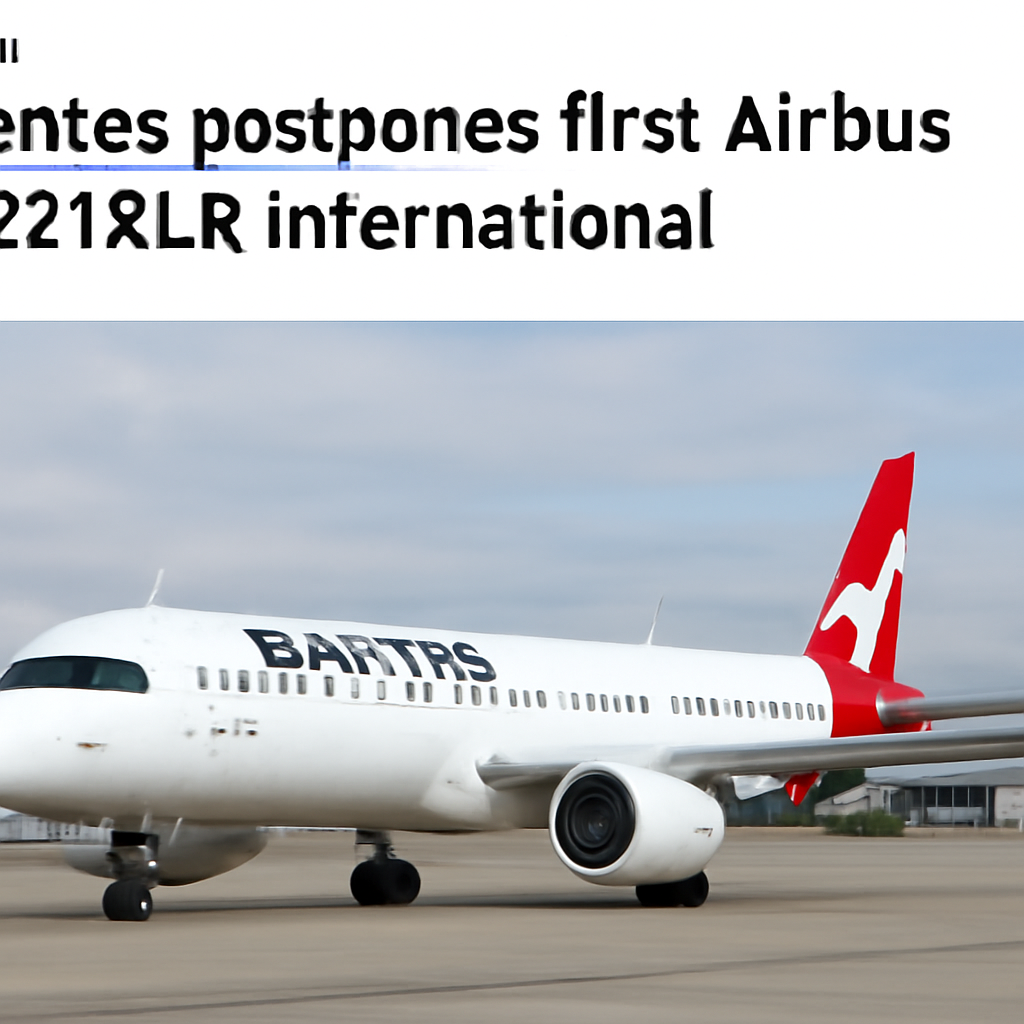

Every week, airlines around the globe report schedule modifications to Cirium Diio, OAG, and other platforms. In the most recent update, Qantas announced a significant alteration to its first international service utilizing the Airbus A321XLR. The launch has been rescheduled for next year.
According to Ch-aviation, the oneworld member currently possesses seven XLRs. These aircraft can carry more fuel due to a higher maximum takeoff weight (MTOW), albeit with a reduced impact on payload. The XLR can transport more cargo compared to the standard A321neo and the LR, neither of which are in Qantas’ fleet. The latest delivery occurred in June 2026, featuring a substantial 197 seats.
Qantas Delays First Scheduled International Service
Prior to the weekend’s announcement, Australia’s national airline was set to launch the XLR service from Brisbane Airport (BNE) to Manila’s Ninoy Aquino International Airport (MNL) on October 25, 2026. This date coincides with the transition to winter schedules for northern carriers, which does not include Qantas. The updated information indicates that the 197-seat XLR will now debut on February 1, 2027. However, there is a possibility that this international launch date may change again.
This route is not new; Qantas operated flights between BNE and MNL until 2013, with services resuming in 2024. The Airbus A330-200 will be utilized in 2026, operating until January 31, 2027. The delay of the XLR means that the designated A330 will remain in service on this route. For the first time, the route will operate daily in late 2026, using the A330 instead of the initially intended XLR. This frequency will persist throughout 2027.
Four Domestic XLR Routes For Now
Currently, Qantas has four active routes utilizing the XLR, as detailed below. With seven aircraft seating between 197 and 200 passengers, these planes are relatively heavier than those operated by most other carriers of the variant. While not direct comparisons, American Airlines’ models have 155 seats, Iberia’s have 182 seats, and Aer Lingus’ have 184 seats. The ultra-low-cost carrier Wizz Air has 239 seats, but this is an exception, as that airline has discontinued its two longest routes.
Qantas’ 197 to 200-seat configurations are arguably more suited for domestic markets and international destinations like the popular Bali rather than long-haul routes. Compared to other narrowbody aircraft, including Qantas’ Boeing 737-800s, the XLR’s increased payload and fuel capacity are advantageous for long domestic routes. Additionally, the ability to carry more freight should enhance operational performance.
From a passenger standpoint, there are 20 business class seats available, none of which are lie-flat, while the economy section consists of 177 to 180 seats. At least 16 of Qantas’ future XLRs will feature lie-flat seats for long-haul operations, including the BNE-MNL route and the future network. It is not surprising that the airline has described the XLR as the ‘ideal aircraft’ for airports like Adelaide Airport (ADL).
Australia To The Philippines
In the year leading up to May 2026, booking statistics indicate that around 1.1 million round-trip passengers traveled between Australia and the Philippines. This figure represents a year-over-year increase of approximately 13%, driven by the introduction of more nonstop routes. The market is primarily composed of the Filipino diaspora and inbound tourists.
The BNE-MNL route is one of Qantas’ two services to the Philippines, with the other being from SYD to MNL, which operates daily, typically using the A330-200. Qantas’ low-cost subsidiary, Jetstar, also has two routes to the Southeast Asian country: BNE to Cebu and PER to MNL, both of which commenced in 2025.
Additionally, Philippine Airlines and Cebu Pacific operate in the region. The flag carrier connects MNL with BNE, MEL, PER, and SYD, while the low-cost airline services MNL to MEL and SYD. When considering all four airlines, Philippine Airlines holds the largest market share, accounting for 40% of the available flights from August 2026 to the following March.
Source: Original article