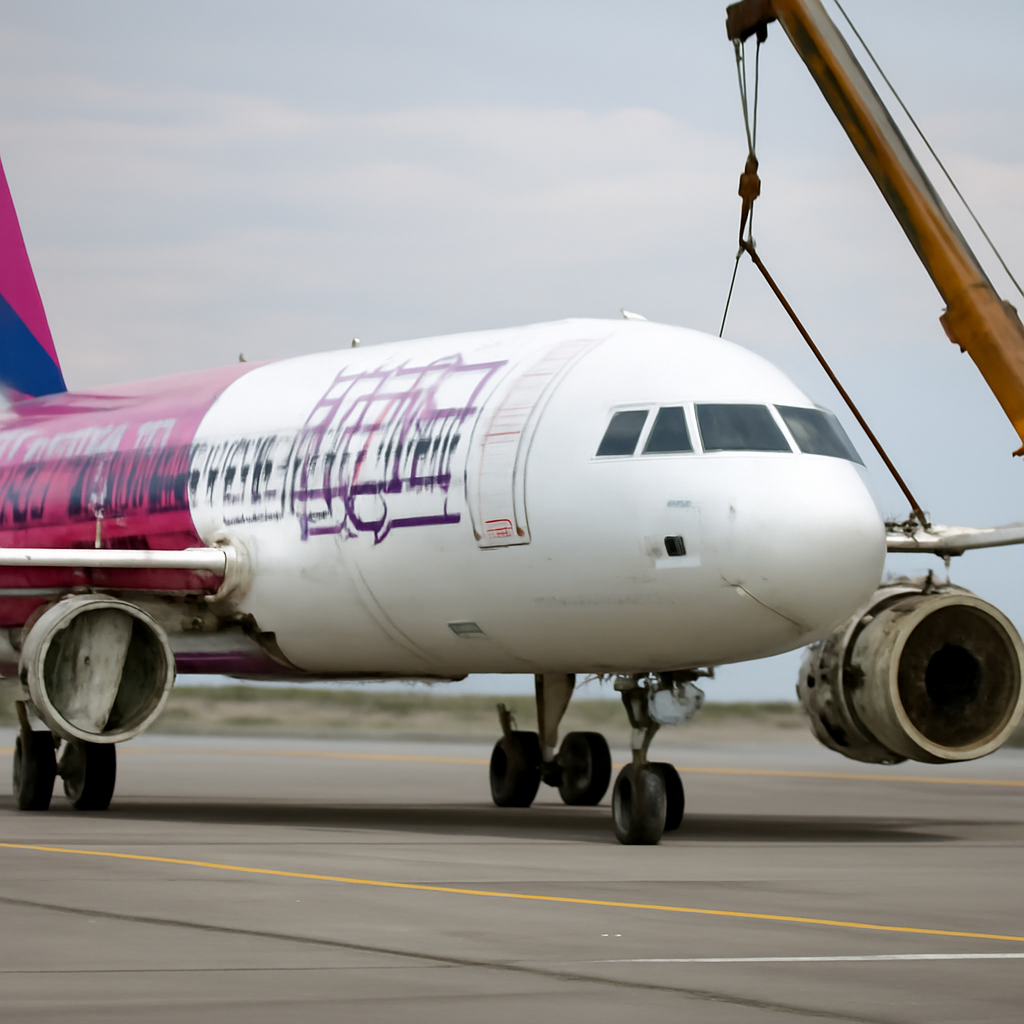

Something unusual is occurring in Poland, where three Airbus A321XLRs belonging to Wizz Air are currently stationed at Bydgoszcz Ignacy Jan Paderewski Airport (BZG). These aircraft are brand new, and the A321XLR is the latest commercial model in operation, yet these three Wizz Air planes are not in the air.
Additionally, the airline has detached the engines from all three planes, effectively cannibalizing them for parts while fitting the engines onto its regular A321neos. The rationale behind Wizz Air’s actions is that both its A321neo and A321XLR fleets utilize the Pratt & Whitney PW1100G engine. Although these are distinct aircraft variants, they share the same engine type.
The PW1100G has encountered considerable durability problems, leading to frequent maintenance visits, and Pratt & Whitney has struggled to repair the engines promptly, resulting in grounded aircraft. Wizz Air’s decision to remove engines from its A321XLRs aims to power more A321neos, but it is peculiar that the airline is resorting to its A321XLRs for this purpose.
Wizz Air And The A321XLR
Currently, Wizz Air operates 208 Airbus A321neos, which includes nine A321XLRs. The oldest of these, 9H-XLA, is just over a year old, and the airline plans to operate a total of 11 units. These aircraft are configured with 239 seats in an all-economy arrangement, similar to the carrier’s A321neos.
Except for the exit rows, Wizz Air configures these planes with a pitch of 28 to 29 inches (71.1 to 73.7 centimeters), and the seats lack features such as seatback screens, power ports, adjustable headrests, or recline. The airline employs the PW1100G engine across its A321neos, which poses challenges given the issues associated with this engine.
Wizz Air has nearly two dozen A321neos grounded, primarily due to engine problems, accounting for almost ten percent of its fleet. Pratt & Whitney is struggling with maintenance, repair, and overhaul (MRO) capacity to swiftly fix engines and is facing challenges in producing new engines, resulting in new aircraft being delivered without engines while operational planes remain inactive. This is where three of Wizz Air’s A321XLRs come into play. These planes are equipped with nearly new engines, prompting Wizz Air to remove them for use on standard A321neos.
Indeed, the engines have been installed on regular A321neos instead. The A321neo is arguably the most cost-effective narrowbody airliner currently in operation, making it logical for Wizz Air to prioritize keeping as many of these planes operational as possible. However, it is strange that the airline is cannibalizing new A321XLRs, which are fundamentally the same aircraft but optimized for longer flights. The reality is that Wizz Air has lost interest in the A321XLR.
Buyer’s Remorse For The XLR
Despite the celebratory image above, Wizz Air’s experience with the Airbus A321XLR has not been ideal. The aircraft themselves have proven reliable and are nearly identical to the airline’s familiar A321neos, but the economic performance of the plane has not met expectations.
The airline has canceled its routes from the UK to the Middle East, and the five A321XLRs currently in operation (with a fourth XLR parked for maintenance) are mainly flying within Europe, along with a few routes from Italy to the Middle East (which do not fully utilize the XLR’s capabilities).
Wizz Air’s Chief Commercial Officer mentioned that the aircraft does not align with its business model without a premium cabin, while the airline’s CEO noted that the aircraft was underperforming in terms of range and payload capacity. However, the most revealing detail is that Wizz Air initially had 47 orders for the XLR but later converted 36 of those orders to the standard A321neo.
The aircraft are not being pushed to their limits, and Wizz Air is now removing their engines to keep older A321neos operational, with only two more A321XLRs expected to be delivered in the future. Although they are quite similar, the A321XLR is a heavier aircraft than the Airbus A321neo due to its design for longer routes and heavier payloads, which results in slightly higher fuel consumption.
Consequently, on two- or three-hour routes within Europe,
Source: Original article