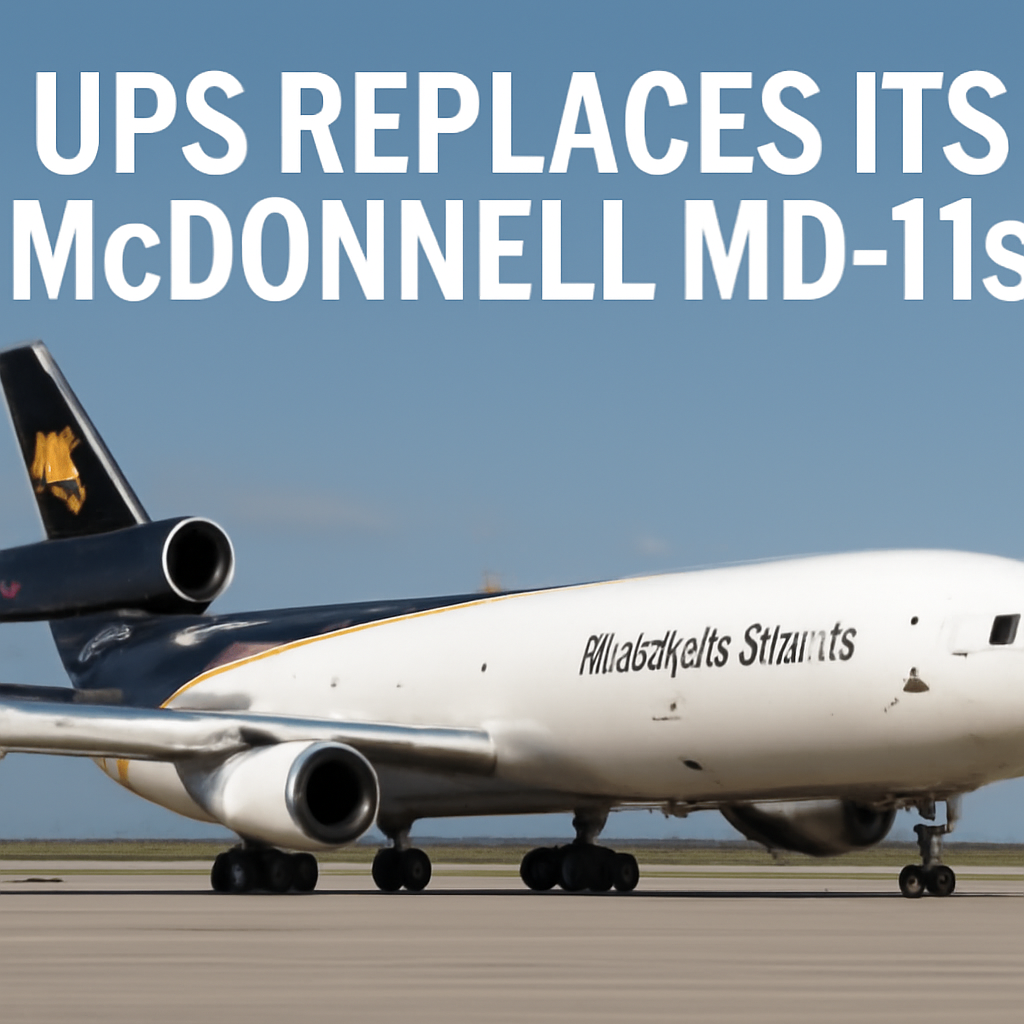

In January, UPS Airlines revealed plans to retire its full fleet of 27 McDonnell Douglas MD-11 widebody cargo aircraft, opting instead for the newer Boeing 767-300F. This decision followed the tragic crash at Louisville Muhammad Ali International Airport (SDF) in November 2025, which resulted in the deaths of both the flight crew and bystanders on the ground. While flight safety was undoubtedly a major concern, the ultimate choice regarding the aging trijets was influenced by business considerations.
The investigation into UPS flight 2976 uncovered a significant failure in the left-wing engine pylon, necessitating extensive non-destructive testing of the remaining aircraft in the fleet. This situation left UPS with more than two dozen planes grounded. In contrast to FedEx, which has returned its MD-11s to service, UPS decided to write off the entire fleet, incurring a loss of nearly $140 million. Attempting to bring the MD-11s back into operation would likely have resulted in similar financial losses due to prolonged downtime.
Moreover, there was the additional risk of uncovering further faults, leading to the scrapping of airframes anyway. However, the more modern 767 has a significantly lower total weight and a smaller overall payload volume compared to the older trijet. Yet, in the current air freight market, which has been shaped by the post-COVID-19 eCommerce surge, the 767’s enhanced fuel efficiency compensates for these drawbacks. Sacrificing 30% of payload for a 35% improvement in fuel efficiency makes the emergency fleet reorganization a forward-looking investment in multiple aspects.
What The Smaller Freighter Sacrifices
While the heavy MD-11 trijet was designed for substantial intercontinental payloads, the 767 excels in transporting high-volume, low-density cargo due to its fuel-efficient design features. The primary reason the 767 leads today’s air freight market is its cargo density. In an era dominated by e-commerce, most packages loaded into the fuselage are lightweight despite their size.
The MD-11F provides approximately 25% more volume than the 767-300F, but it operates with three engines and incurs a significantly higher fuel burn at every stage of flight just to travel from point A to point B. The cargo variant of the 767 boasts a 35% reduction in fuel consumption compared to the older trijet. This statistic alone has established it as the ‘champion’ of express air shipping in the post-COVID-19 marketplace.
Additionally, the 767 features near-perfect mechanical reliability and a streamlined maintenance program due to more advanced technology, ensuring that aircraft spend less time in the hangar and more time in the air. E-commerce demands near-perfect dispatch reliability to fulfill delivery commitments.
Furthermore, the smaller twinjet is quieter and requires a smaller operational footprint at any airfield. This capability enables operators like UPS, FedEx, and Amazon Prime Air to utilize the 767 at smaller airports closer to end-consumers, avoiding congested international mega-hubs.
Why Parcels Rarely Require The Full Payload
Express freight operates differently than bulk cargo. Packages typically occupy cabin space before reaching a jet’s weight limit, meaning that a freighter’s container positions often determine how much it can carry rather than its weight capacity. This is where a notable similarity between the two jets undermines the MD-11’s payload advantage once again, as their main deck areas are nearly the same size.
Despite being a considerably larger aircraft, the MD-11 only accommodates two more pallets than the 767, totaling 26 compared to the twinjet’s maximum of 24. Losing just two pallet positions represents a minimal volume sacrifice for express logistics operators. The slight reduction in floor space is entirely overshadowed by the 767’s superior efficiency.
E-commerce packages primarily consist of lightweight items, protective bubble wrap, and oversized cardboard boxes. Due to the low density of this type of freight, an aircraft fills its physical cabin space, known as ‘cubing out,’ long before the cargo weight approaches its limit.
Source: Original article