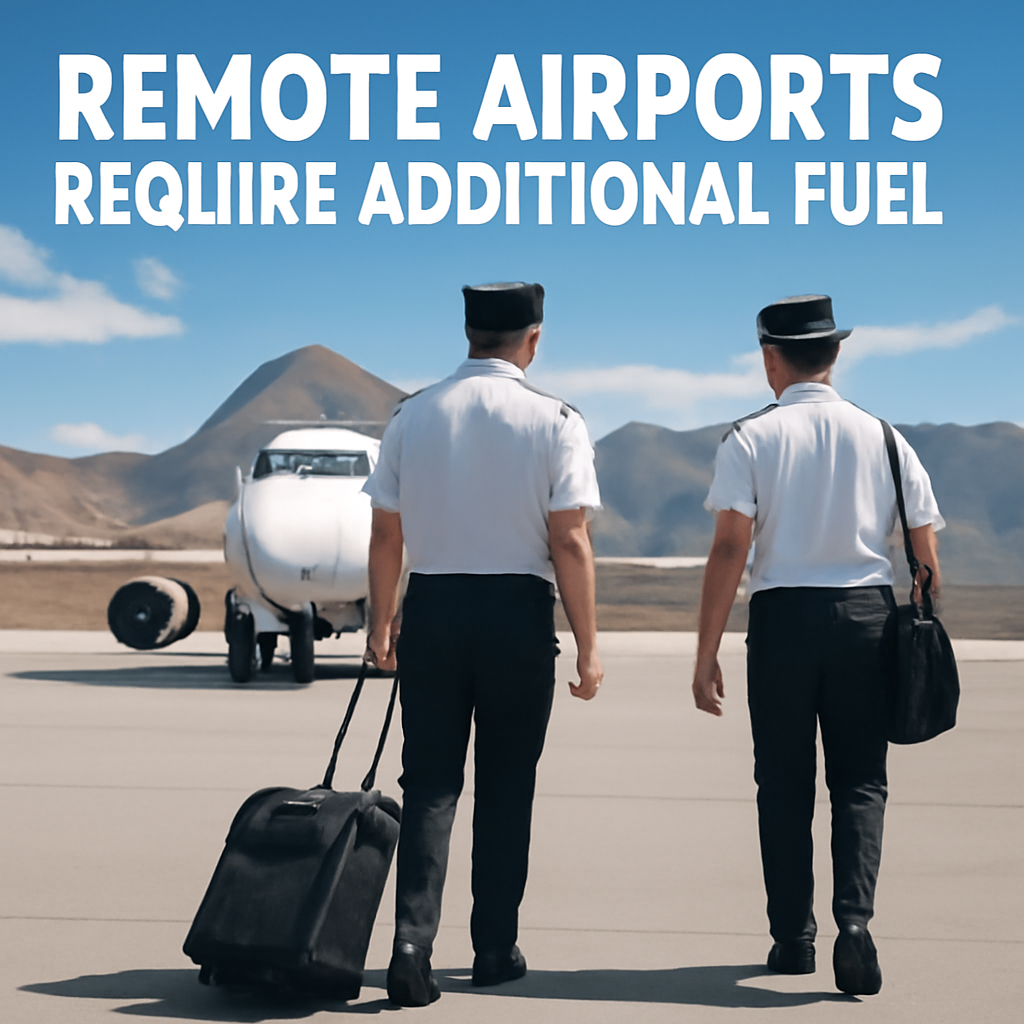

Fuel management is a crucial element of international aviation. Typically, an aircraft departs with sufficient fuel to arrive at its destination, prepare for unexpected situations, divert to an alternate airport if needed, and still have a reserve. However, this calculation becomes significantly more complex when the destination is far removed from any other viable runway. At the most remote airports globally, pilots and dispatchers must contemplate what occurs once the aircraft reaches its point of no return.
The European Union Aviation Safety Agency (EASA) has established specific guidelines for such scenarios. According to its March 2026 Easy Access Rules, an operator may classify a destination as an isolated aerodrome if the fuel needed to reach the nearest adequate alternate destination, including final reserve fuel, surpasses a defined threshold. For turbine-powered aircraft, this threshold is two hours of normal cruise fuel consumption beyond the destination, which includes final reserve fuel. EASA clarifies that these two hours encompass a 30-minute final reserve, leaving around 90 minutes for holding at the destination.
However, this does not imply that every airport mentioned below is officially recognized as an ‘isolated aerodrome’ under the same regulations. Fuel requirements differ based on the operator, type of aircraft, weather conditions, available alternates, and jurisdiction. Instead, these six airports illustrate the geographical factors that make fuel planning for isolated destinations particularly critical.
6 Norfolk Island Airport
The South Pacific location has limited practical diversion options.
Norfolk Island Airport (NLK) caters to the Australian territory of Norfolk Island in the South Pacific. According to Australia’s Department of Infrastructure, the island is situated about 994 miles (1,600 km) northeast of Sydney, 553 miles (890 km) northeast of Lord Howe Island, and 684 miles (1,100 km) northwest of Auckland. Regular passenger flights operate from Sydney and Brisbane, as per the Australian Government’s Norfolk Island travel information.
This geographical context immediately alters the fuel-planning landscape compared to a standard domestic flight on the mainland. Although Lord Howe Island is closer in proximity than mainland Australia, the nearest runway on a map does not necessarily qualify as a suitable alternate. Dispatchers must take into account runway characteristics, weather, airport operating conditions, aircraft performance, and the operator’s approved procedures.
Australia has also focused regulatory attention on fuel planning for remote islands. An investigation by the Australian Transport Safety Bureau into fuel planning revealed that flights to designated Australian remote islands, including Norfolk Island, Lord Howe Island, and Christmas Island, necessitated special fuel considerations. The ATSB documented operator procedures mandating that remote-island flights carry an alternate and that isolated-aerodrome flights maintain fuel for two hours after reaching the aerodrome, including fixed reserve fuel.
Norfolk Island exemplifies why ‘extra fuel’ is not merely a matter of adding a random number of gallons or kilograms. The operator must ascertain what genuine alternatives exist and plan accordingly. EASA’s isolated-aerodrome regulations highlight this principle by requiring the operational flight plan to define a point of no return when the isolated-aerodrome scheme is applied.
5 Christmas Island Airport
The nearest Australian mainland alternative is separated by a vast ocean expanse.
Christmas Island Airport (XCH) serves another Australian external territory located in the Indian Ocean. According to Australia’s Department of Infrastructure, Christmas Island is approximately 1,616 miles (2,600 km) northwest of Perth and only about 304 miles (490 km) southwest of Jakarta, as stated in the Australian Government’s Christmas Island location and transport information.
The island’s geographical location means that the conventional mainland airport network is not accessible. Perth is thousands of kilometers away.
Source: Original article