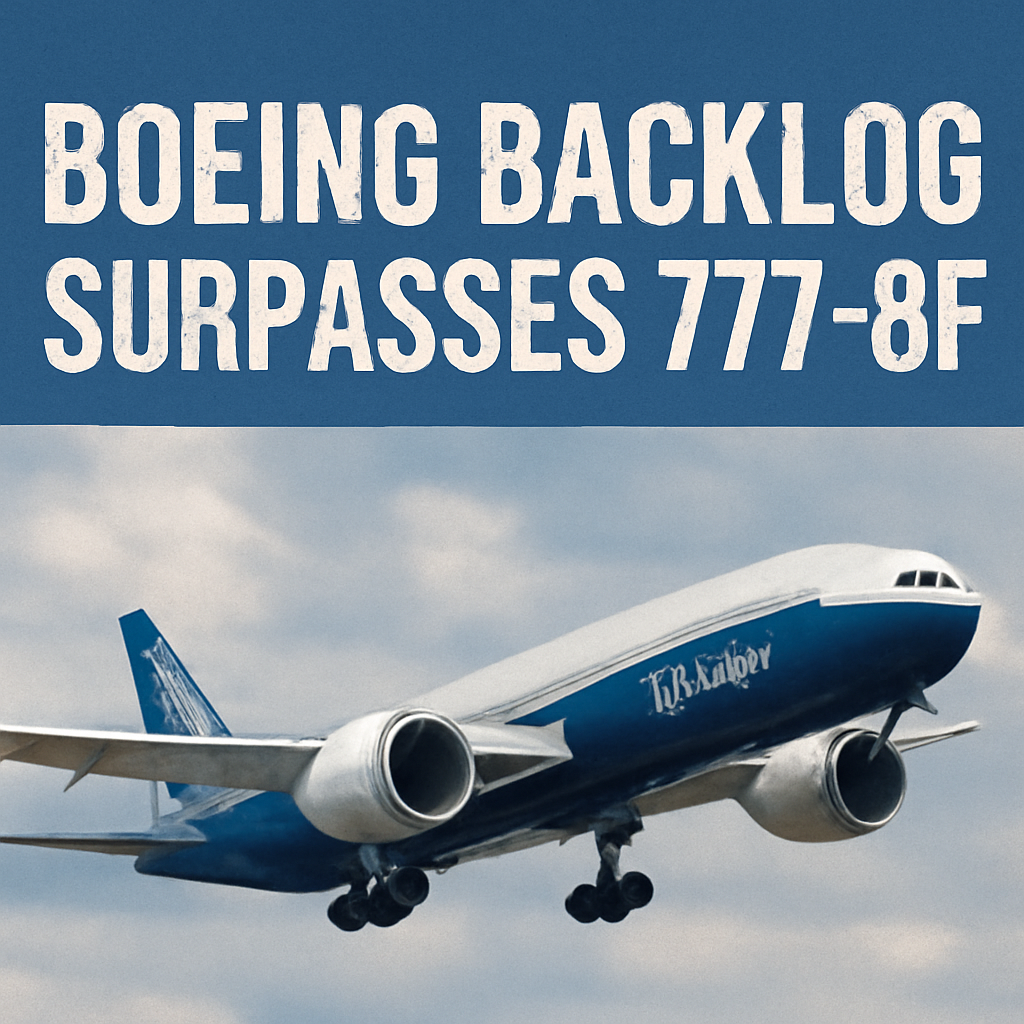

At the 2026 Farnborough International Airshow, MSC Air Cargo placed an order for five Boeing 777-8F Freighters, revealing itself as the previously anonymous customer in Boeing’s order records and marking its inaugural commitment to the Boeing 777X series. This order positions MSC as the third European operator of this aircraft type and boosts Boeing’s confirmed backlog of 777-8F jets to over 80, even though the aircraft has yet to commence operations. The 777-8F is intended to replace the aging Boeing 747-400Fs and the current 777Fs, whose production is set to conclude before the 2028 international emissions regulations take effect.
This decision is significant as MSC is primarily recognized as one of the largest container shipping firms globally, yet it has opted to invest in a next-generation freighter that has not yet taken to the skies. This move goes beyond merely expanding its air cargo capabilities; it reflects a comprehensive long-term strategy aimed at enhancing its logistics network and adapting to future shifts in the global freight landscape. This article delves into the main reasons behind MSC Air Cargo’s choice to order the Boeing 777-8 Freighter.
MSC Air Cargo has finally disclosed its identity as Boeing’s mystery customer. The Boeing 777-8 Freighter, a cargo variant of the 777X family, was developed to succeed the highly successful 777 Freighter and ultimately replace the aging fleets of Boeing 747-400F and MD-11F. Boeing initiated the program in 2022 after confirming that production of the current 777F will cease after 2027, as new international aircraft emissions regulations will hinder further certification of the existing model. Consequently, the 777-8F has emerged as Boeing’s long-term answer for the large widebody freighter market.
At the 2026 Farnborough International Airshow, MSC Air Cargo announced its order for five Boeing 777-8 Freighters, marking its first commitment to the 777X family. This order also identified MSC as the previously unnamed customer already recorded in Boeing’s order book. The five new aircraft will eventually enhance the carrier’s existing fleet of seven Boeing 777 Freighters, aiding its ongoing growth as the air cargo division of the MSC Group. This latest commitment raises Boeing’s confirmed backlog of 777-8F aircraft to over 80.
MSC is now the third operator based in Europe to place an order for this type, following Lufthansa Cargo and Cargolux. Other customers include Qatar Airways Cargo, Silk Way West Airlines, China Airlines, China Southern Airlines, and Korean Air. Although the 777-8F has yet to conduct its inaugural flight, MSC’s decision to commit at this stage reflects confidence in both Boeing’s next-generation freighter and the long-term prospects for global air cargo demand.
Despite the Boeing 777-8 Freighter not having flown yet, MSC Air Cargo has already made a commitment to the program. The order first appeared in Boeing’s backlog in December under an unidentified customer before being officially announced at the 2026 Farnborough International Airshow. CEO Jannie Davel described the purchase as “an investment in the long-term future of MSC Air Cargo and in the customers we serve,” emphasizing that the company is looking beyond the current cargo market. By placing an early order, MSC also secures important production slots for an aircraft anticipated to be in high demand once it begins operations.
The decision is motivated by more than just acquiring a capable freighter. The 777-8F has been engineered to comply with future regulatory and operational standards, offering up to 30% improved fuel efficiency and reduced carbon emissions per payload tonne compared to older aircraft like the Boeing 747-400 Freighter. Starting in 2028, stricter ICAO emissions regulations will prevent the certification of additional units of the current 777 Freighter, making next-generation aircraft crucial for future fleet renewal. Although Boeing is pursuing a temporary exemption for the existing 777F while the 777-8F program progresses (expected to enter service in early 2029), airlines will inevitably require a long-term replacement.
Source: Original article