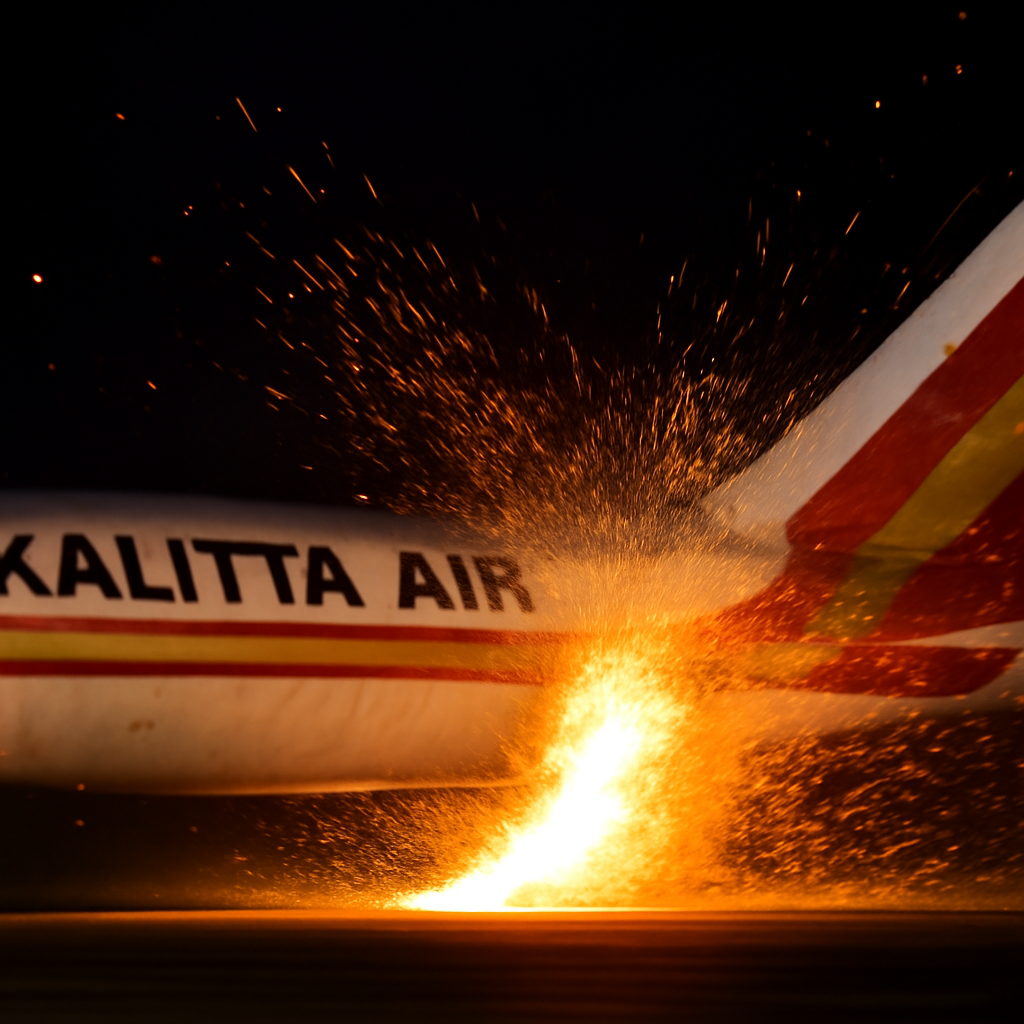

Sparks erupted at Cincinnati Northern Kentucky International Airport (CVG) when a Kalitta Air cargo plane experienced a tail strike while attempting to land. Initial reports shared by the FAA on X indicate that the aircraft, operating as K4 264, scraped the runway during a go-around maneuver. Fortunately, the plane was able to land safely shortly thereafter.
The Boeing 777-300 had arrived from Brussels after a trans-Atlantic flight on Sunday. As it approached Cincinnati for landing, it encountered a tail strike. Witnesses recorded the event, which quickly circulated on social media. Kalitta Air has confirmed that the aircraft has been taken out of service pending an investigation before being sent to the airline’s maintenance facility in Michigan.
According to flight data, the aircraft, registered as N778CK, departed from Brussels Airport (BRU) on Sunday, July 19, at 5:47 PM, completing an eight-hour and 32-minute journey across the Atlantic to Cincinnati. Upon arrival at CVG, the plane was attempting to land when the tail strike occurred during a go-around.
There have been no reports of injuries among those on board. Kalitta’s Chief Operating Officer, Heath Nicholl, confirmed that the aircraft landed safely and has been removed from service. The latest flight data indicates that the plane is scheduled to fly to Oscoda–Wurtsmith Airport (OSC) this evening, where the airline conducts its heavy maintenance.
As reported by FOX19, the aircraft experienced a tail skid during an attempted landing at Cincinnati, which was characterized by a rough approach at the busy logistics hub. Nicholl stated, “The event is under review, and we do not have any additional information to provide at this time.”
Aircraft Details: N778CK
The aircraft involved in the incident is a 21.4-year-old 777-36NERSF, registered as N778CK, with serial number (MSN) 32789. It first entered commercial service in 2005 with Emirates in Dubai and is powered by two General Electric GE90-115B engines, having completed its first test flight on March 9, 2005.
Upon delivery to Emirates on March 30, 2005, it operated under United Arab Emirates registration A6-EBB. The aircraft was leased from GE Capital Aviation Services (GECAS) and was stored multiple times between March and June 2018, as well as from February 2020. It was later transferred to Kalitta Air on September 11, 2025. Additional aircraft details are available from ch-aviation.
The conversion of the aircraft from passenger to freighter was carried out by IAI (Israel Aerospace Industries), and it has since been utilized by Kalitta Air for long-haul cargo operations. Kalitta Air has acquired these aircraft as part of a fleet modernization initiative to replace aging 747-400 freighters.
What Occurs During a Tail Strike?
A tail strike happens when the rear fuselage of an aircraft contacts the runway, which can occur during takeoff or landing. This is often caused by the nose being pulled up too quickly or too high. Other contributing factors may include landing with an incorrect pitch or during strong winds.
The immediate effects of a tail strike can result in structural damage due to the impact, which can crush the metal on the underside of the aircraft’s tail and potentially compromise the pressurized fuselage. Typically, pilots will execute a go-around after such an event to allow for inspection before proceeding with scheduled operations.
In the case of Kalitta Air’s recent incident in Cincinnati, the damage will be addressed at its maintenance facility in Michigan before the aircraft returns to regular service.
Source: Original article